Warning: Cannot modify header information - headers already sent by (output started at /home/xs301118/sparx.blog/public_html/wp-content/themes/blogus-child/single.php:26) in /home/xs301118/sparx.blog/public_html/wp-content/themes/blogus-child/functions.php on line 66
Technical Architecture Perspective: The Brilliance of Decoupled Design for Both Blazing-Fast UI and Robust AI Processing
Warning: Cannot modify header information - headers already sent by (output started at /home/xs301118/sparx.blog/public_html/wp-content/themes/blogus-child/single.php:26) in /home/xs301118/sparx.blog/public_html/wp-content/themes/blogus-child/functions.php on line 66
Users interacting with inspireXgrowth might first be struck by its smooth operability. However, behind the scenes, complex and resource-intensive AI processing is constantly running. This article delves into the secrets of inspireXgrowth’s strategic technology selection and architectural design, which reconcile seemingly contradictory requirements: a comfortable user experience and advanced AI functionality.
At the core of our design philosophy lies **”Clear Role Separation.”**
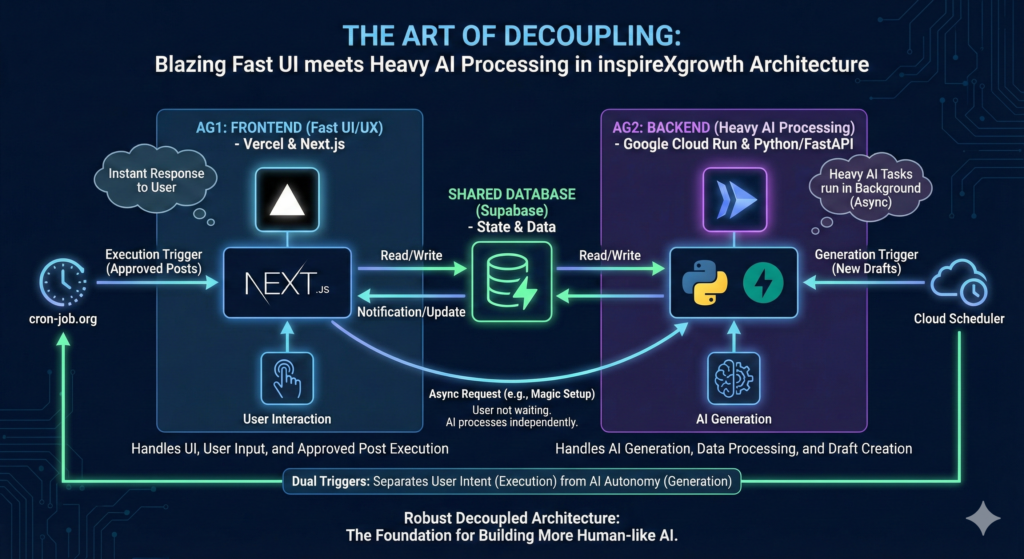
The system is broadly divided into two agents: the frontend “AG1,” which users directly interact with, and the backend “AG2,” responsible for heavy tasks such as AI generation.
* AG1 (Frontend): Next.js on Vercel
* AG2 (Backend): Python/FastAPI on Google Cloud Run
The biggest advantage of this design decision is the ability for each component to specialize in its respective role. AG1 bears full responsibility for UI/UX responsiveness, reacting instantly to every user action. Meanwhile, AG2 asynchronously handles time-consuming AI generation and data processing without making users wait.
For instance, consider “Magic Setup,” inspireXgrowth’s killer feature. With this function, users simply input some information, and the AI extracts their brand DNA. Once the user completes their input, AG1 immediately responds with “Request received” and releases the UI. Behind the scenes, AG1 asynchronously delegates all the heavy processing to AG2. After AG2 finishes interacting with the AI and writes the results to the database, users can later view the results on their screen. This asynchronous design aims to achieve both perceived user speed and AI processing power.
This philosophy of “role separation” is also evident in the automatic posting mechanism. Why use two different triggers? It’s to clearly separate “user intent” from “AI autonomy.”
1. **Scheduled Post Execution (AG1):** Triggered by cron-job.org, AG1 **executes approved posts.** This is a “confirmed future” that the user has sanctioned.
2. **Automatic Post Generation (AG2):** Triggered by Cloud Scheduler, AG2 **automatically generates new post drafts.** This is a “creative future” proposing new possibilities.
This separation is our answer to maximizing the benefits of AI without compromising user control. And it is this robust architecture that allows us to focus on our next challenge: developing a “more human-like AI.” In the next article, we will delve into its core.
#Nextjs #FastAPI #CloudRun #Architecture #SystemDesign