Warning: Cannot modify header information - headers already sent by (output started at /home/xs301118/sparx.blog/public_html/wp-content/themes/blogus-child/single.php:26) in /home/xs301118/sparx.blog/public_html/wp-content/themes/blogus-child/functions.php on line 66
Chapter 2: Four Years Running a Software Business with a Small Team
Warning: Cannot modify header information - headers already sent by (output started at /home/xs301118/sparx.blog/public_html/wp-content/themes/blogus-child/single.php:26) in /home/xs301118/sparx.blog/public_html/wp-content/themes/blogus-child/functions.php on line 66
Chapter 2: Running a Software Business with a Small Team for Four Years
The Challenge of Giving MS-DOS a “Face” on the Eve of Windows
As someone who had only dabbled in programming, my initial passion was in the realm of “how to present technology.”
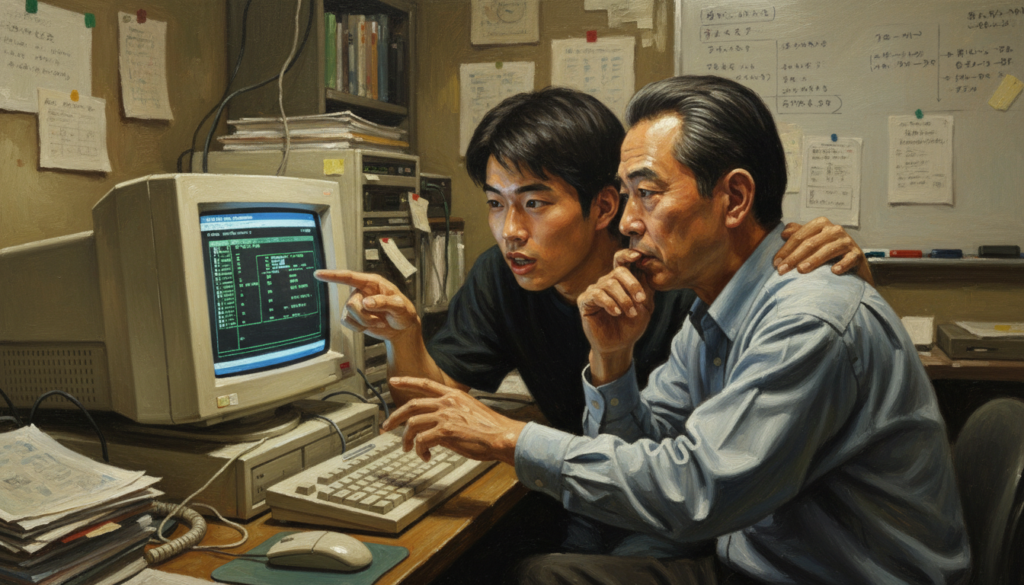
This was the early 1990s, a time before Windows had become widely popular. PCs typically featured a CUI (Character User Interface) with just white text on a black background. In this environment, we plunged ourselves into the extremely niche and highly demanding world of “measurement and control software.”
This software would graph data or control equipment used in factories and research laboratories. We aimed to give these seemingly inorganic tools a graphical user interface. How could we create an easy-to-use and visually appealing “face” on the rugged foundation of MS-DOS? That was my first mission.
A Battle with the Global Giant, Texas Instruments (TI)
Our team was astonishingly small. There was the department head responsible for development, myself, and a few staff members. With a setup akin to a “software division of a small local factory,” we were facing the global giant, Texas Instruments (TI).
Their software was the world standard, possessing overwhelming reliability and brand power. In contrast, we were an obscure, small team from Japan. Logically, we shouldn’t have even been in the running. Nevertheless, we visited major Japanese companies – the engineers at the forefront of their R&D, design, production, and quality control departments.
“TI’s software is indeed impressive. But which software is truly solving your current inconveniences in the Japanese field?”
Together with the department head, we traveled across the country, visiting these sites. This was long before “solution selling” became a common term. We would grasp the subtle “itch that needed scratching” that field engineers had, translate it into software specifications, and present prototypes with “How about this?” the following week. That sense of speed and grit was our greatest weapon.
The Sensitivity to Translate “Technology” into “Business”
Ultimately, this venture, after about four years of struggle, did not lead to a world-shattering success. In 1995, I resigned from that company.
However, the experience from those four years left me with a deep-seated understanding: “Technology only comes alive when it becomes a ‘product’ that solves someone’s problem.”
Simply being able to write programs is not enough. Having an interesting concept is also insufficient. The true essence of business lies in the process of translating the language of the field into the language of technology and then shaping it into something that makes people think, “Buying this will change my future.”
At the time, by working alongside a formidable engineer like the department head, I believe I naturally developed this perspective.
A “Tangible Feel” That Connects to Modern AI Development
Today, I am developing an AI agent product (inspireXgrowth).
The MS-DOS screens of the 1990s and the AI chat interfaces of the 2020s. While the technological layers are entirely different, I often feel that what we are doing is surprisingly similar.
“How do we transform cutting-edge technology into tools with a tangible feel for the user?”
“How do we reach the ‘distortions’ in the field that are beyond the reach of the standard features offered by large corporations?”
The discussions about the usability of measurement and control software that the department head and I passionately had back then live on within me today, albeit in a different form. Chapter 2 is an indispensable page in reflecting on how this “original experience in a small team” cast a shadow on my later business philosophy.
[Next Chapter Preview] In an era when the internet was still underdeveloped, I stepped into the wilderness of “independence.” Advertising production, flyer distribution, and later the wave of the “stock material business.” A harsh reality awaited me just before my thirties.